
Arman Zarei
Author
In this notebook, we talk about GANs, conditional GANs, Wasserstein GAN variants, and PyTorch implementations.

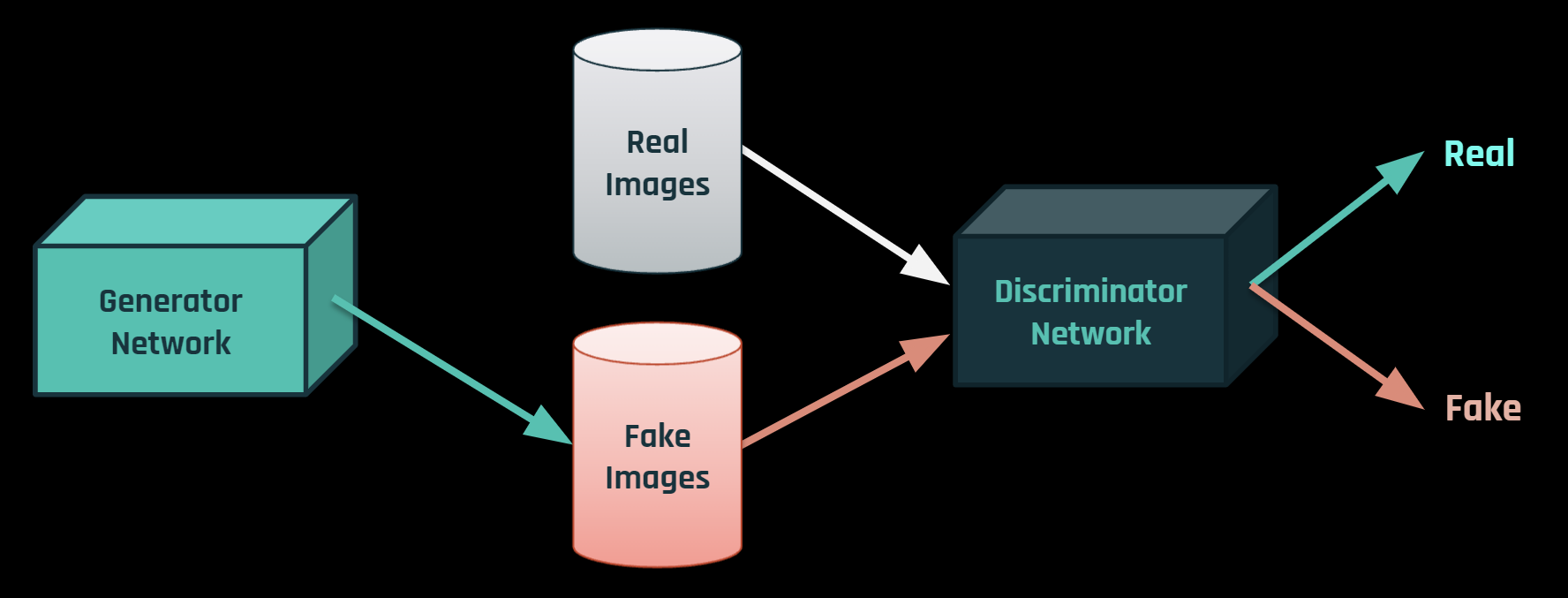
First, Lets define some notations:
So, $D(G(z))$ is the probability (scalar) that the output of the generator GG is a real image. As described in Goodfellow’s paper, $D$ and $G$ play a minimax game in which DD tries to maximize the probability it correctly classifies reals and fakes ($logD(x)$), and $G$ tries to minimize the probability that $D$ will predict its outputs are fake ($log(1-D(G(z)))$). From the paper, the GAN loss function is: $$ \min_{G}\max_{D}V(D, G) = \mathbb{E}_{x \sim p_{data}(x)} [logD(x)] + \mathbb{E}_{z \sim p_{z}(z)} [log(1 - D(G(z)))] $$ In theory, the solution to this minimax game is where $p_g=p_{data}$, and the discriminator guesses randomly if the inputs are real or fake. However, the convergence theory of GANs is still being actively researched and in reality models do not always train to this point.
Many variations of GANs were introduced which may have changed the loss function or etc. but the main idea of generator and disriminator remains still. In the next section we're going to see a version of it.
import torch
import torch.nn as nn
import torch.optim as optim
import torchvision.datasets as datasets
import torchvision.transforms as transforms
from torch.utils.data import DataLoader
from tqdm import tqdm
import torchvision
import matplotlib.pyplot as plt
C:\Users\Arman_PC\AppData\Local\Programs\Python\Python37\lib\site-packages\torchvision\io\image.py:11: UserWarning: Failed to load image Python extension: [WinError 126] The specified module could not be found
  warn(f"Failed to load image Python extension: {e}")
class Discriminator(nn.Module):
    def __init__(self, channels_img, features_d):
        super(Discriminator, self).__init__()
        self.disc = nn.Sequential(
            nn.Conv2d(channels_img, features_d, kernel_size=4, stride=2, padding=1),
            nn.LeakyReLU(0.2),
            self._block(features_d, features_d * 2, 4, 2, 1),
            self._block(features_d * 2, features_d * 4, 4, 2, 1),
            self._block(features_d * 4, features_d * 8, 4, 2, 1),
            nn.Conv2d(features_d * 8, 1, kernel_size=4, stride=2, padding=0),
        )

    def _block(self, in_channels, out_channels, kernel_size, stride, padding):
        return nn.Sequential(
            nn.Conv2d(
                in_channels, out_channels, kernel_size, stride, padding, bias=False,
            ),
            nn.InstanceNorm2d(out_channels, affine=True),
            nn.LeakyReLU(0.2),
        )

    def forward(self, x):
        return self.disc(x)

class Generator(nn.Module):
    def __init__(self, channels_noise, channels_img, features_g):
        super(Generator, self).__init__()
        self.net = nn.Sequential(
            self._block(channels_noise, features_g * 16, 4, 1, 0),
            self._block(features_g * 16, features_g * 8, 4, 2, 1),
            self._block(features_g * 8, features_g * 4, 4, 2, 1),
            self._block(features_g * 4, features_g * 2, 4, 2, 1),
            nn.ConvTranspose2d(
                features_g * 2, channels_img, kernel_size=4, stride=2, padding=1
            ),
            nn.Tanh(),
        )

    def _block(self, in_channels, out_channels, kernel_size, stride, padding):
        return nn.Sequential(
            nn.ConvTranspose2d(
                in_channels, out_channels, kernel_size, stride, padding, bias=False,
            ),
            nn.BatchNorm2d(out_channels),
            nn.ReLU(),
        )

    def forward(self, x):
        return self.net(x)

def initialize_weights(model):
    for m in model.modules():
        if isinstance(m, (nn.Conv2d, nn.ConvTranspose2d, nn.BatchNorm2d)):
            nn.init.normal_(m.weight.data, 0.0, 0.02)
def gradient_penalty(critic, real, fake, device="cpu"):
    BATCH_SIZE, C, H, W = real.shape
    alpha = torch.rand((BATCH_SIZE, 1, 1, 1)).repeat(1, C, H, W).to(device)
    interpolated_images = real * alpha + fake * (1 - alpha)

    mixed_scores = critic(interpolated_images)

    gradient = torch.autograd.grad(
        inputs=interpolated_images,
        outputs=mixed_scores,
        grad_outputs=torch.ones_like(mixed_scores),
        create_graph=True,
        retain_graph=True,
    )[0]
    gradient = gradient.view(gradient.shape[0], -1)
    gradient_norm = gradient.norm(2, dim=1)
    gradient_penalty = torch.mean((gradient_norm - 1) ** 2)

    return gradient_penalty
device = "cuda" if torch.cuda.is_available() else "cpu"
LEARNING_RATE = 1e-4
BATCH_SIZE = 64
IMAGE_SIZE = 64
CHANNELS_IMG = 1
Z_DIM = 100
NUM_EPOCHS = 20
FEATURES_CRITIC = 16
FEATURES_GEN = 16
CRITIC_ITERATIONS = 5
LAMBDA_GP = 10
transform = transforms.Compose(
    [
        transforms.Resize(IMAGE_SIZE),
        transforms.ToTensor(),
        transforms.Normalize(
            [0.5 for _ in range(CHANNELS_IMG)], [0.5 for _ in range(CHANNELS_IMG)]),
    ]
)
dataset = datasets.MNIST(root="dataset/", transform=transform, download=True)
loader = DataLoader(
    dataset,
    batch_size=BATCH_SIZE,
    shuffle=True,
)
gen = Generator(Z_DIM, CHANNELS_IMG, FEATURES_GEN).to(device)
critic = Discriminator(CHANNELS_IMG, FEATURES_CRITIC).to(device)
initialize_weights(gen)
initialize_weights(critic)
opt_gen = optim.Adam(gen.parameters(), lr=LEARNING_RATE, betas=(0.0, 0.9))
opt_critic = optim.Adam(critic.parameters(), lr=LEARNING_RATE, betas=(0.0, 0.9))
gen.train()
critic.train()

for epoch in tqdm(range(NUM_EPOCHS)):
    for batch_idx, (real, _) in enumerate(loader):
        real = real.to(device)
        cur_batch_size = real.shape[0]

        for _ in range(CRITIC_ITERATIONS):
            noise = torch.randn(cur_batch_size, Z_DIM, 1, 1).to(device)
            fake = gen(noise)
            critic_real = critic(real).reshape(-1)
            critic_fake = critic(fake).reshape(-1)
            gp = gradient_penalty(critic, real, fake, device=device)
            loss_critic = (
                -(torch.mean(critic_real) - torch.mean(critic_fake)) + LAMBDA_GP * gp
            )
            critic.zero_grad()
            loss_critic.backward(retain_graph=True)
            opt_critic.step()

        gen_fake = critic(fake).reshape(-1)
        loss_gen = -torch.mean(gen_fake)
        gen.zero_grad()
        loss_gen.backward()
        opt_gen.step()

torch.save(gen.state_dict(), 'checkpoints/wgan-gp_gen.pth')
torch.save(critic.state_dict(), 'checkpoints/wgan-gp_critic.pth')
100%|██████████| 20/20 [1:06:42<00:00, 200.14s/it]
gen.load_state_dict(torch.load('checkpoints/wgan-gp_gen.pth'))
critic.load_state_dict(torch.load('checkpoints/wgan-gp_critic.pth'));
Generating random numbers
z = torch.randn(100, Z_DIM, 1, 1).to(device)
gen_imgs = gen(z)

plt.figure(figsize=(15, 15))
plt.axis('off')
plt.imshow(torchvision.utils.make_grid(gen_imgs, normalize=True, nrow=10).cpu().permute(1, 2, 0));


class Discriminator(nn.Module):
    def __init__(self, channels_img, features_d, num_classes, img_size):
        super(Discriminator, self).__init__()
        self.img_size = img_size
        self.disc = nn.Sequential(
            nn.Conv2d(channels_img+1, features_d, kernel_size=4, stride=2, padding=1),
            nn.LeakyReLU(0.2),
            self._block(features_d, features_d * 2, 4, 2, 1),
            self._block(features_d * 2, features_d * 4, 4, 2, 1),
            self._block(features_d * 4, features_d * 8, 4, 2, 1),
            nn.Conv2d(features_d * 8, 1, kernel_size=4, stride=2, padding=0),
        )
        self.embed = nn.Embedding(num_classes, img_size*img_size)

    def _block(self, in_channels, out_channels, kernel_size, stride, padding):
        return nn.Sequential(
            nn.Conv2d(
                in_channels, out_channels, kernel_size, stride, padding, bias=False,
            ),
            nn.InstanceNorm2d(out_channels, affine=True),
            nn.LeakyReLU(0.2),
        )

    def forward(self, x, labels):
        embedding = self.embed(labels).view(labels.shape[0], 1, self.img_size, self.img_size)
        x = torch.cat([x, embedding], dim=1)
        return self.disc(x)

class Generator(nn.Module):
    def __init__(self, channels_noise, channels_img, features_g, num_classes, embed_size):
        super(Generator, self).__init__()
        self.net = nn.Sequential(
            self._block(channels_noise+embed_size, features_g * 16, 4, 1, 0),
            self._block(features_g * 16, features_g * 8, 4, 2, 1),
            self._block(features_g * 8, features_g * 4, 4, 2, 1),
            self._block(features_g * 4, features_g * 2, 4, 2, 1),
            nn.ConvTranspose2d(
                features_g * 2, channels_img, kernel_size=4, stride=2, padding=1
            ),
            nn.Tanh(),
        )
        self.embed = nn.Embedding(num_classes, embed_size)

    def _block(self, in_channels, out_channels, kernel_size, stride, padding):
        return nn.Sequential(
            nn.ConvTranspose2d(
                in_channels, out_channels, kernel_size, stride, padding, bias=False,
            ),
            nn.BatchNorm2d(out_channels),
            nn.ReLU(),
        )

    def forward(self, x, labels):
        embedding = self.embed(labels).unsqueeze(2).unsqueeze(3)
        x = torch.cat([x, embedding], dim=1)
        return self.net(x)
def gradient_penalty(critic, labels, real, fake, device="cpu"):
    BATCH_SIZE, C, H, W = real.shape
    alpha = torch.rand((BATCH_SIZE, 1, 1, 1)).repeat(1, C, H, W).to(device)
    interpolated_images = real * alpha + fake * (1 - alpha)

    mixed_scores = critic(interpolated_images, labels)

    gradient = torch.autograd.grad(
        inputs=interpolated_images,
        outputs=mixed_scores,
        grad_outputs=torch.ones_like(mixed_scores),
        create_graph=True,
        retain_graph=True,
    )[0]
    gradient = gradient.view(gradient.shape[0], -1)
    gradient_norm = gradient.norm(2, dim=1)
    gradient_penalty = torch.mean((gradient_norm - 1) ** 2)

    return gradient_penalty
NUM_CLASSES = 10
GEN_EMBEDDING = 100
gen = Generator(Z_DIM, CHANNELS_IMG, FEATURES_GEN, NUM_CLASSES, GEN_EMBEDDING).to(device)
critic = Discriminator(CHANNELS_IMG, FEATURES_CRITIC, NUM_CLASSES, IMAGE_SIZE).to(device)
initialize_weights(gen)
initialize_weights(critic)
opt_gen = optim.Adam(gen.parameters(), lr=LEARNING_RATE, betas=(0.0, 0.9))
opt_critic = optim.Adam(critic.parameters(), lr=LEARNING_RATE, betas=(0.0, 0.9))
gen.train()
critic.train()

for epoch in tqdm(range(NUM_EPOCHS)):
    for batch_idx, (real, labels) in enumerate(loader):
        real, labels = real.to(device), labels.to(device)
        cur_batch_size = real.shape[0]

        for _ in range(CRITIC_ITERATIONS):
            noise = torch.randn(cur_batch_size, Z_DIM, 1, 1).to(device)
            fake = gen(noise, labels)
            critic_real = critic(real, labels).reshape(-1)
            critic_fake = critic(fake, labels).reshape(-1)
            gp = gradient_penalty(critic, labels, real, fake, device=device)
            loss_critic = (
                -(torch.mean(critic_real) - torch.mean(critic_fake)) + LAMBDA_GP * gp
            )
            critic.zero_grad()
            loss_critic.backward(retain_graph=True)
            opt_critic.step()

        gen_fake = critic(fake, labels).reshape(-1)
        loss_gen = -torch.mean(gen_fake)
        gen.zero_grad()
        loss_gen.backward()
        opt_gen.step()

torch.save(gen.state_dict(), 'checkpoints/cwgan-gp_gen.pth')
torch.save(critic.state_dict(), 'checkpoints/cwgan-gp_critic.pth')
100%|██████████| 20/20 [1:11:39<00:00, 214.95s/it]
gen.load_state_dict(torch.load('checkpoints/cwgan-gp_gen.pth'))
critic.load_state_dict(torch.load('checkpoints/cwgan-gp_critic.pth'));
z = torch.randn(90, Z_DIM, 1, 1).to(device)
labels = torch.arange(1, 10).repeat_interleave(10).to(device)
gen_imgs = gen(z, labels)

plt.figure(figsize=(15, 15))
plt.axis('off')
plt.imshow(torchvision.utils.make_grid(gen_imgs, normalize=True, nrow=10).cpu().permute(1, 2, 0));

You can read about different types of GAN from here. In these series of videos you will learn about:
